Musings and beginnings of plans about how to make crawl-style RPGs that don’t produce narratives of violence.
Intro
In a lot of media, exploration and combat go hand-in-hand, and for good reasons. Violence provides an extremely legible and intuitive threat to characters, our cultural media landscape has plenty of different modes and archetypes of violence to draw upon to provide variety in settings and characters, and violent interactions have a certain finality to them: a slain villain or monster generally doesn’t wake back up tomorrow and keep causing problems. In terms of games, we have many traditions of creating satisfying mechanics for simulating (or at least representing) violence of varying levels of realism. However, I’ve found that the ease of accessing violence, whether as a setting or story element or as a focus of character customization and mechanics, makes non-violent scenarios, characters, and mechanics hard to imagine.
So, as an exercise in practicing my creativity, I started thinking of how one could implement a dungeon crawl which did not feature violence. In my mind, the first step of this exercise is figuring out what makes a dungeon crawl effective as a framing device for both a narrative scenario and a set of mechanics. In my mind, it comes down to:
- Exploration of an unknown space
- Risks to the characters
- Rewards to justify taking the risks
- Ability to make meaningful decisions about how (or whether) to tackle risks
In a traditional dungeon crawl, you have adventurers exploring an unfamiliar location, facing traps and monsters, and looking for loot (or working their way towards some narrative goal). They might have a variety of abilities to use in tactical combat and exploration, giving plenty of options for actions to take moment-to-moment. They will also have access to other, more strategic decisions, like determining which of multiple routes to take; when and where to rest; and whether to retreat or push on when the going gets tough. Depending on the game, the fail state may be as minor as losing a disposable character and pulling out a backup sheet to continue the module, or as severe as ending a hundred-hour playthrough of a roguelike.
The challenge I’ve given myself, then, is identifying potential alternatives that could support a similar range of game mechanics, a similar set of considerations to present players with, and a similar tension between the players’ positive and negative desires.
Concept A: Rescue
Fortunately, around the time I first started thinking about this, Tom Scott’s England series was getting started. Episode 4, “These people walk towards mining disasters.” (YouTube / Nebula) made me realize that rescue operations could be a very strong fit. Tom’s descriptions of how disorienting dark and smoky tight spaces can be are very evocative, and even in the simplified training exercise the team was doing, they still had a good deal of different tasks to do, with different people focusing on different aspects of the situations they were in.
In a similar vein, I’ve played a decent amount of Flash Point: Fire Rescue, and believe that game’s mechanics would be a fantastic starting point for fleshing out something more focused on longer-term campaign play; there are already a good variety of specializations which either provide unique abilities or improve the efficiency of a common ability, and the set of common abilities give a decent variety of ways to interact with the game world, at least for the purpose of dealing with a structure fire and rescue.
So, imagine you’re running a mine fire rescue operation as a tabletop RPG. Maybe you give the players a simplified map of what the location should theoretically look like, but between potential cave-ins and the smoke and dust obscuring passageways in the dark (or just out-of-date documents), it could still be easy (or at least possible) to get lost and disoriented by missing a turn. As the PCs navigate the tunnels, they need to be ensuring the safety of the area, checking and shoring up supports, ensuring power is cut in areas with gas leaks, and regularly checking their own equipment. Meanwhile, any victims along the way may need to be treated and evacuated. There’s a set of standard operating procedures in real life here, but in a game you could set up situations where this is a decision point: does your whole team stop and evacuate a victim you meet along the way, do you leave the victim in place to evacuate on your way out while your team moves ahead, do you split up? What are you risking, and what opportunities are you passing up?
In the partially collapsed chamber with a victim pinned under a fallen support beam, what are your players’ priorities? If they follow SOP and shore up the ceiling before treating the victim, will they have enough time to save his life? Can they even shore up the ceiling before it collapses? Maybe there’s a fire spreading towards some unsecured explosives; can they hold it off long enough to retreat? Can they pull the victim to safety? Does somebody get left behind?
And of course, a modern realistic setting is not the only possibility here; what dangers might be lurking in the mana crystal mines? Or in the construction site for the underground dwarven highway?
Second Idea: Hacking
One criticism I vaguely remember reading of Shadowrun is that if the party has a decker, that means the GM has to run two RPGs at once. While of course that critique is understandable, it does hint that perhaps the hacking sub-game could be its own distinct game.
Now, I don’t have much personal experience with Shadowrun (outside the fantastic Harebrained Schemes CRPGs), but I poked at the Shadowrun 4e book for its hacking rules, and they seemed to have a decent amount of depth, with at least some space for specializing within those mechanics. I am a little more familiar with the Cyberpunk setting and books, and I feel like for this concept, the hacking mechanics from Cyberpunk 2020 have more to offer. Particularly relevant to this thought exercise, target systems are already essentially constructed as dungeons on a grid map. With some additional complexity, I think the concepts there could be fleshed out into something geared towards a whole party.
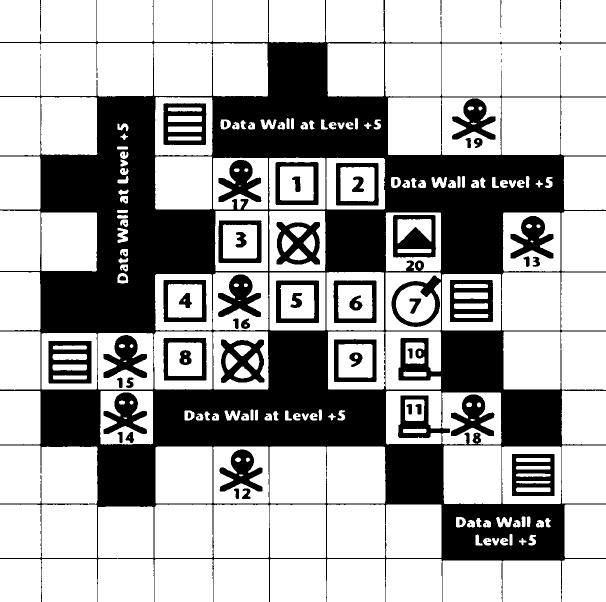
In general, a simulacrum of hacking ought to involve a handful of different categories of tasks:
- Casing/Observation/Exploration. Preliminary research to map out networks, traffic patterns, and find potential vulnerabilities. (Though in the event of pretty serious misconfiguration, you might just be done at this step; that realism would probably would be anticlimactic in an RPG though)
- Exploitation. Take what you learned from observation and use that to get more access than you’re supposed to have. Maybe this means using known vulnerabilities in outdated software, maybe this means actually using some stolen credentials (and possibly doing some more observation with the elevated access).
- Modification. Make changes to the system you’re in; install malware or keyloggers, destroy files, impersonate somebody to send messages, leave a ransom note, change public-facing sites to brag about how you owned the company, mess with industrial systems. There’s a whole lot to potentially do here.
- Exfiltration. Just obtaining access to data isn’t enough, if you want to use it later you need to copy it outside of the system that wants to keep it secret. Actually moving large amounts of information outside of a protected system without alerting automated systems designed to detect data exfiltration is its own challenge.
- Obfuscation. You need to avoid alerting the operators of the target system for at least the time it takes to accomplish your goals. And ideally, even if/when they figure out what happened and start tracing back to who compromised their systems, they won’t connect it all the way back to you. Although even getting caught and booted out once isn’t necessarily the end of the action; one avenue of attack may get closed off, but there could be more vulnerabilities to exploit.
Now, it doesn’t necessarily make sense for these five categories to map 1:1 onto character specializations; exploration and obfuscation are somewhat continuous actions that everybody can be engaged in. Exploitation can cover a wide range of activities; maybe one character is good at applying existing exploits for known vulnerabilities, another is good at the longer-term work of identifying unknown vulnerabilities and developing new exploits, and a third is good at convincing people to send them their passwords.
Possibility III: Long Distance Travel
Hey. Have you heard of Oregon Trail? Yeah, the old point-crawl party-based permadeath RPG.
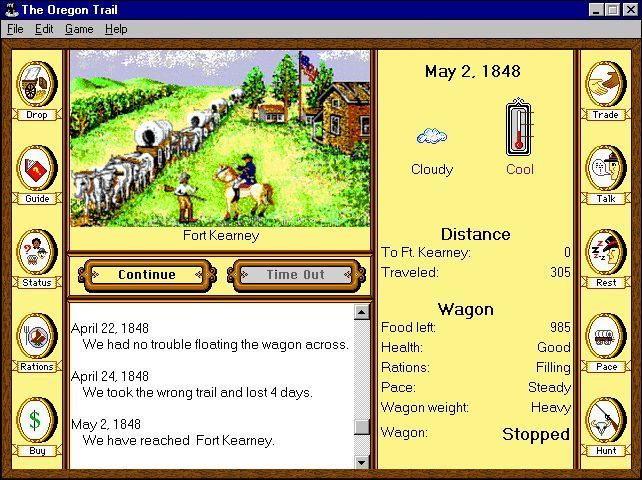
This gets a bit away from my original thinking, as long distance travel isn’t exactly what you’d call a dungeon crawl due to the lack of a dungeon. But otherwise it does tick the same boxes, and hey, Caves of Qud and Elin get to be called “Traditional Roguelikes” despite a lot of the game taking place on the overworld map.
Of course, there’s been a great deal of attention paid to travel in RPGs already. But that’s a similar situation as to how hacking mechanics in RPGs tend to be bundled with games that spend a lot of word count on simulating physical violence. What would your random travel event tables look like if monsters, bandits, and other combat enemies are absent? How does a party of traveling adventurers who aren’t planning on getting into fights prepare for a long journey? What character abilities and constraints make sense for a system that’s more focused on wilderness survival, navigation, and long-term resource management? How do you differentiate characters while giving multiple players something interesting to do in any given scene?
This concept is the one I feel the least confident about, in part because it gets so close to the design space of more traditional combat-focused RPGs which I’m familiar with that I keep veering off towards combat concepts, like a wheel getting stuck in a rut on the road. I feel like Oregon Trail proves that the concept has legs for a single player game, but I’m not sure how one might add enough mechanical variety to give multiple players something to do besides debate navigation decisions.
Of course, part of that is, I think, “long distance travel” is actually incredibly broad. How far is “long distance”? What technologies do the characters have access to? How typical is it in the characters’ cultures to undertake such journeys? For what purpose are they traveling? Medieval peasants walking together across England for a pilgrimage, truckers trying to cross the state line before getting caught by the sheriff, runaway kids hitchhiking, Austornesian-speaking peoples sailing great distances for trade or exploration, Silk Road merchants trying to make a profitable trip, and people departing a failing city-state in search of a spot of land to settle down on are all very different stories that I think ought to be treated very differently.
Conclusion
While I’m certainly not opposed to violence in fiction (I am, after all, a USAmerican, so that’s basically inescapable), violence is pretty clearly over-represented in our media, including RPGs. I think that by taking inspiration from the interesting, difficult, and extreme things people are doing today, have done in the past, and do in fiction, there’s a lot of opportunity for engaging roleplaying games that produce different narratives than we’re used to seeing. And furthermore, developing mechanics doesn’t have to be done fully from scratch; there are plenty of board games and video games to draw ideas and inspiration from.